

The spectroscopy facilities
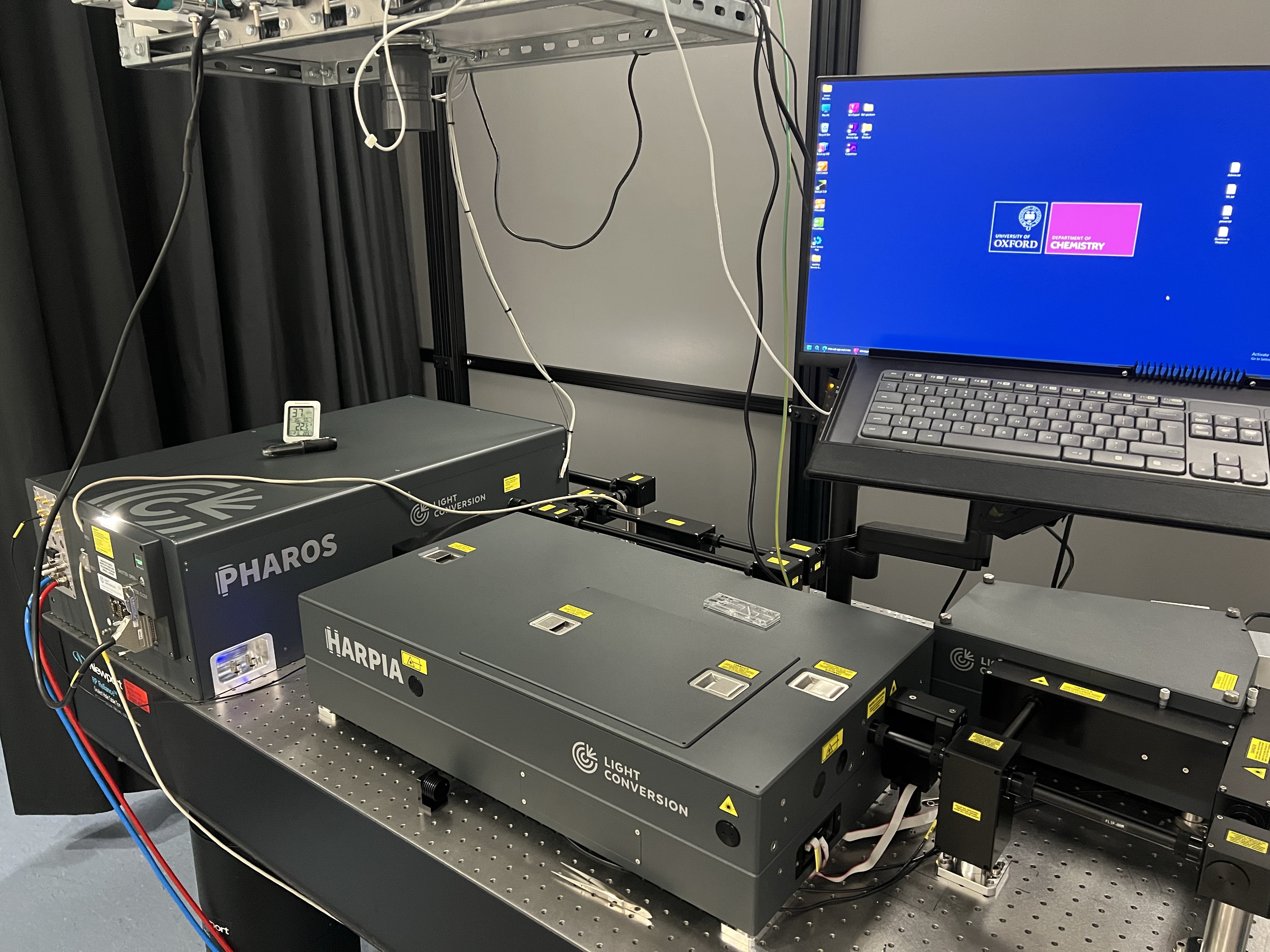
Figure 1. fs-TAS system combining Light Conversion PHAROS femtosecond laser with a HARPIA-TA spectroscopy system.
Ultrafast Transient Absorption Spectroscopy
Many of the processes that determine how well a energy conversion material performs occur almost immediately after it absorbs light. Femtosecond transient absorption spectroscopy (fs-TAS) acts like an ultrafast camera, allowing us to follow these early changes and understand what happens to the absorbed energy.
In an fs-TAS experiment, a very short laser pulse is used to excite the sample. This pulse lasts only femtoseconds. A second broadband pulse then measures how the sample’s absorption has changed after a precisely controlled time interval. By gradually changing the interval between the two pulses, we build up a series of snapshots showing how the material responds over time and at different wavelengths.
The spectral and kinetic information can be used to investigate carrier cooling, exciton dissociation, charge and energy transfer, trapping, and recombination. The spectral and kinetic information can be used to investigate carrier cooling, exciton dissociation, charge and energy transfer, trapping, and recombination. These insights provide a deeper understanding of the fundamental mechanisms governing the behaviour and performance of photoactive materials.
Our fs-TAS facility combines a Light Conversion PHAROS femtosecond laser with a HARPIA-TA spectroscopy system and a tunable excitation source. Its broadband probe covers wavelengths from approximately 350 nm in the ultraviolet to 1700 nm in the near-infrared. The system offers sub-200 fs time resolution, follows light-induced changes over several nanoseconds, and supports both transmission and reflection measurements. These capabilities make it a powerful and versatile platform for uncovering ultrafast processes in a wide range of materials

Figure 1. Placeholder
Microsecond Transient Absorption Spectroscopy
Time-resolved optical spectroscopic techniques measure the change in probe light absorption by a sample in response to an excitation source. Charge carriers in a given material have characteristic absorption wavelengths, so by probing at a specific wavelength it is possible to track the change in population of a specific charge carrier over time.
In microsecond transient absorption spectroscopy (µs-TAS), the excitation source is a ns laser pulse to photoexcite a sample, allowing for measurements of transient decay signals over the µs-s timescale. The data give information about the yield and lifetime of photogenerated charge carriers, and can be used to provide insights into the kinetic competitions affecting sample performance. Transient photocurrent (TPC) measurements can be carried out by modifying the setup such that the oscilloscope measures the photocurrent response to the laser pulse as a function of time.
We have four spectroscopy systems that can be used for µs-TAS measurements in transmission mode, one of which can also be used to measure in reflectance mode (useful for highly scattering samples). Two of these setups utilise Opolette lasers that can be tuned to a range of excitation wavelengths. Our systems are run by home-built LabVIEW software.
Figure 1. Placeholder
Photoinduced Absorption Spectroscopy (PIA)
Photoinduced absorption spectroscopy (PIA) is a steady state technique that utilises the same optical setups used for µs-TAS but excites the sample with a longer (typically ~ 5-20 s) LED pump rather than with a laser pulse. For photoelectrodes, the photocurrent response can be measured simultaneously with the change in optical absorption, making it possible to perform rate law analyses and gain insights into reaction mechanisms.
Step-potential spectroelectrochemistry (SP-SEC) is the electrochemical (EC) equivalent of PIA, exciting with a potential step rather than an LED. For suitable materials, obtaining SP-SEC and PIA measurements on the same sample can provide an operando method of accessing the internal quasi-Fermi level splitting.