

The characterisation facilities

Figure 2. Placeholder
UV-Vis Spectrometer (Cary 60) and Fluorescence spectrophotometer (Cary Eclipse)
The Agilent Cary 60 UV-Vis Spectrophotometer is efficient, accurate and flexible, and is designed to meet both current and future measurement needs. The proven, robust design of the Cary 60 comprises a double beam, Czerny-Turner monochromator, 190–1100 nm wavelength range, 1.5 nm fixed spectral bandwidth, full spectrum Xenon pulse lamp single source with exceptionally long life. Scan rates up to 24,000 nm min-1, 80 data points/sec maximum measurement rate, room light immunity, central control by PC with Microsoft® Windows® operating system. Optional 21 CFR Part 11 capable software, and dedicated instrument validation software which includes pharmacopeia test suites. The Agilent Cary Eclipse can carry out fluorescence, phosphorescence, chemi/bio-luminescence, and time resolved phosphorescence measurements. It incorporates the unique Agilent xenon flash lamp to capture a data point every 12.5 ms and scans at 24,000 nm min-1 without peak shifts perfect for high throughput laboratories and fast kinetics applications.
Figure 3. Placeholder
Incident Photon-to-current conversion efficiency (IPCE) set up
Incident photon-to-current conversion efficiency measurements are conducted in a setup illustrated in below.
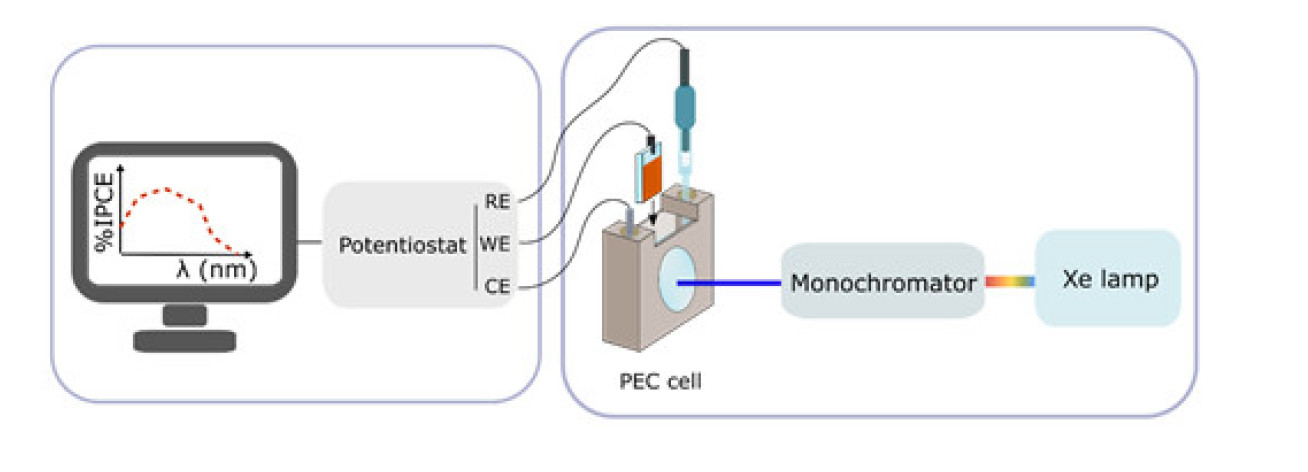
The Xe lamp is fitted with a monochromator (OBB-2001,Photon Technology International). The intensity of the monochromated light is measured using an optical power meter (PM 100, Thorlabs) equipped with a silicon photodiode (S120UV, Thorlabs).
Figure 4. Placeholder
Photoelectrochemical (PCE) set up
The photoelectrochemical (PEC) measurements are usually conducted in a home-built three electrode cell. An Autolab potentiostat (PGSTAT 101, Metrohm) is used to apply the potential to the cell and the data are recorded with Nova software (Metrohm). Measurements such as linear-sweep voltammetry, cyclic voltammetry, chonoamperometry etc. are performed in a home-built photoelectrochemical set-up illustrated below.
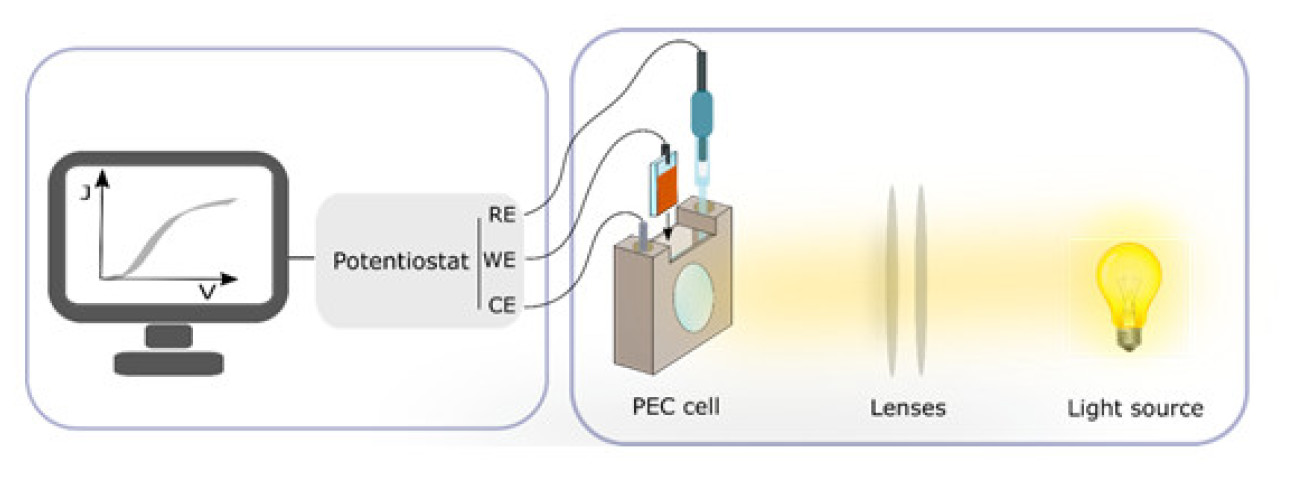
The set-up consists of a Xe-lamp light source, filters and lenses, a home-built three-electrode PEC cell coupled to a potentiostat. To obtain the same photon flux as AM 1.5G at wavelengths lower than 650 nm, the power output of the Xe-light source (75 W, Hammamatsu) is calibrated using a KG3 filter and a Si-photodiode. Integrating the solar AM 1.5G spectrum up to 650 nm, the Si-photodiode should produce a current of 7.2 mA cm-2, which is then used to adjust the position of the sample to correspond to 1 sun irradiation conditions.
Figure 5. Placeholder
UV-Vis and spectroelectrochemistry (SEC)
SEC is a broad term referring to techniques that measure the difference in transmitted, scattered or emitted light as a potential is applied to a material in an electrochemical cell. In the group we specialise in UV-Vis SEC, measuring the changes in absorbance of electrocatalysts of energy conversion reactions such as the Oxygen Evolution Reaction (OER) and the Hydrogen Evolution Reaction (HER). The technique can measure changes in surface redox transitions as they are driven by an external bias. This allows the determination of change in the optical density (ΔOD) of a material resulting from applied potential, and thus oxidation or reduction of sample under steady-state conditions. The data are measured as the difference in the optical absorption spectra as a function of applied potential, with respect to the spectrum at a reference potential. Thus, we can characterise redox state changes, quantify coverages of electroactive species, and identify the active species involved in the electrocatalytical reaction studied.